Hablando de Nuestra Madre

April and May passed celebrating Earth Day, Arbor Day, and Mother’s Day.

Dia de la Tierra- Earth Day. Screenprint arte by Jose G. Gonzalez.

With those connections in mind, I’d like to introduce another way to celebrate a very special mother, La Madre Tierra. The word madre carries a particular strong cultural resonance in Chicano/Latino/Hispano communities, and when it is connected to tierra, it is amplified to strongly connect with a sense of community, belonging, and respect. The Latino identity has strong associations with words madre and tierra: vida, libertad, querida, sagrada, and other words dignifying life, liberty, and sacredness.

The words madre y tierra have long and deep roots in our history and heritage, guided by our mestizo and indigenous identities. The La Madre Tierra project is working on discovering, documenting, sharing, and highlighting those roots via our stories and voices. It is a way to say, “We are here, as part of this environmental and conservation movement, we have been here, this is how, and it has value in moving forward and building on the conservation successes of the past.” This is how we are we are included and valued rather than assimilated; this is how we assert an ambicultural identity rather than being subsumed into another or taken for granted.

La Madre Tierra

La Madre Tierra: Digital arte by Jose G. Gonzalez for lamadretierra.org

In the community, references to the value of how we’re connected to the land are abound as part of our narrative rather than separate from it. That is part of why at times there is a difficulty for some communities in identifying as conservationists or environmentalist from an expected traditional mainstream narrative—we have a conservation cultura rather than thinking we need to add conservation to our culture.

You can look at Emiliano Zapata’s “Tierra Y Libertad” and Reies Tijerina’s land grant movement. You can see the reference to tierra in the Chicano Art Movement and how that continues today with the work of Dignidad Rebelde and Favianna Rodriguez. You can see how we are rooted in the US through Alfredo Figueroa’s La Cuna de Aztlan, and the work of Devon Peña around Tierra y Vida.

Agua Es Vida- Arte by Jesus Barraza. Visit dignidadrebelde.com to support this artist and artist collective.

Agua Es Vida- Screenprint arte by Jesus Barraza. Visit dignidadrebelde.com to support this artist and artist collective.

You can see a history of community-based organizations throughout the US that have existed in connection to the defense of land and community, of La Madre Tierra.

And of course there are all the references throughout Latin America, from Pachamama to Tonantzin—both embodiments of mother earth.

It’s rooted in culture through contemporary songs, embedded in the narrative of Calle 13’s “Latinoamérica” and interpretations of This Land is Your Land, from Lila Downs to Las Cafeteras.

La Madre Tierra is very present in our culture as it is our ecological home. Let’s share our voices and the stories of La Madre Tierra, demonstrate how our Conservation Cultura is displayed, and not only affirm our presence in this work, but remind ourselves of how we’ve been present and how it’s time to come together to move forward together—hay que compartir como estamos conectados con la Madre Tierra.


Encontrando la Natura en la Ciudad: Getting to know the Heath

IMG_0222
Hola mi gente! A big shout out from all the way across the pond where finally, FINALLY, the sun is starting to grace us with it’s, somewhat, sustained presence. As the bitterness of winter slowly fades from London, there is a buzz about the city that is implacable. Tourist season has definitely crept in, add to that all the Londoners who had been eagerly awaiting a chance to catch some vitamin D, and what you have is an explosion of chatter and activity amongst the streets. The city really has come to life as the sun has warmed and so it is my prerogative to make sure I make it to at least one new green space/park every month while I’m here.

This month, I’ll include one that I have grown to love wholeheartedly, Hampstead Heath.

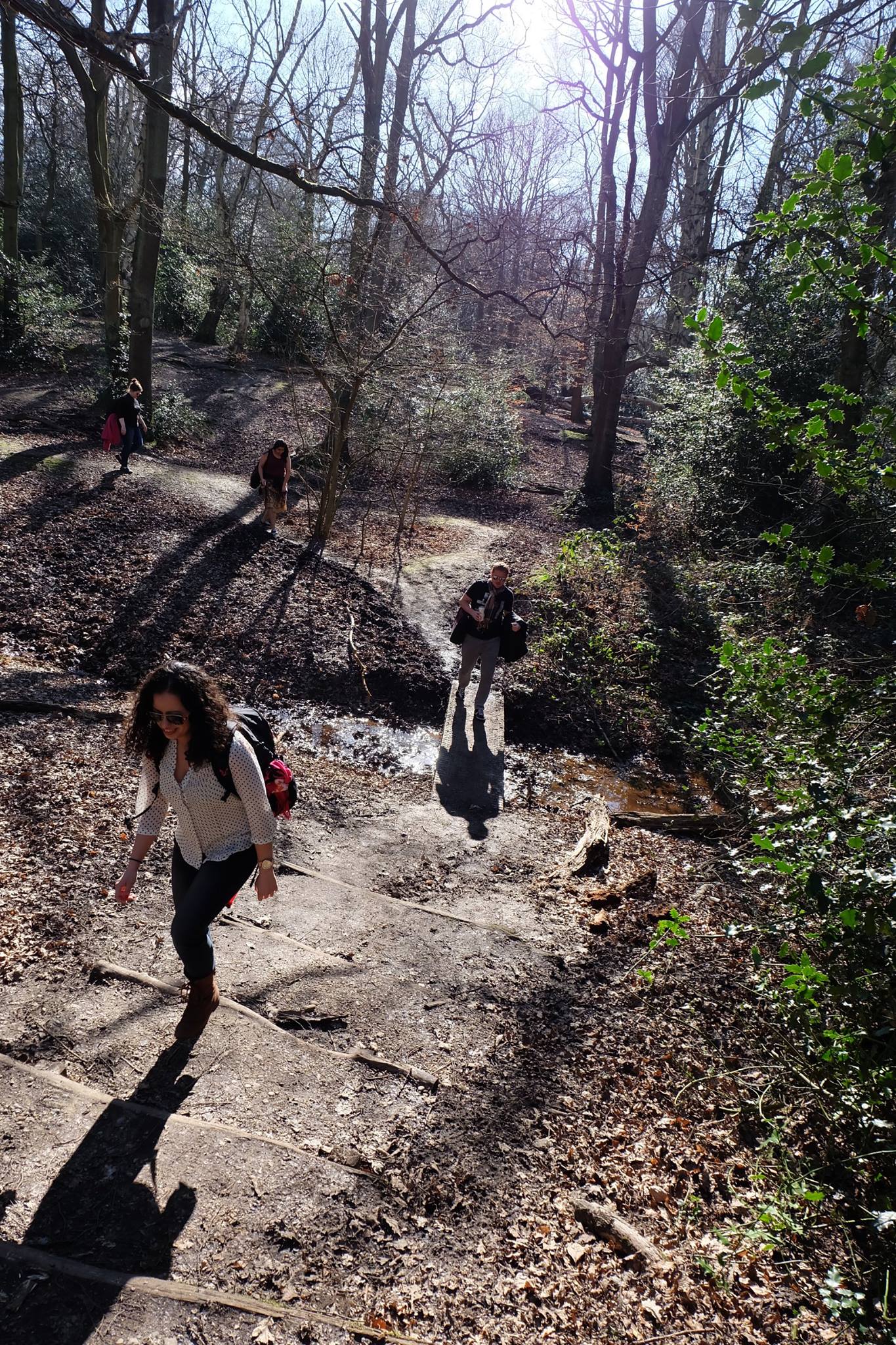
The first trip I took to the Heath happened very sporadically. I forget now whether I had sparked the idea, or whether it had been a friend of mine, but nevertheless by noon I found myself and 5 other friends on our way to the Heath. The sun was out and like any Londoner, we jumped at the slightest possibility that we would be able to bask in some simmering sun for longer than half an hour. Piecing together a veritable feast from some cheeses, a bit of wine, crackers and other snacks, we marched on from our home to the park.

Group Heath Walk                                                                     (Photo Credit: Jean Witters)

The Heath, however, was a place I was just beginning to get to know. Unlike the other things in my life at the time, my classes which were going well, friendships that were blossoming, I was softly, sinking into an intimacy with London which was lifting my spirits substantially. I was beginning to come to grips with some of London’s topography, the hills, the smell of the plants bursting from the soils, the sounds of it early in the mornings when there was but the rush of winds or sharp chirp of bids.

Hampstead Heath, was at on my first visit, new territory. The Heath is a sprawling piece of somewhat wild woodland in the northwestern side of London. It comprises about 320 hectares (roughly 790 acres) and includes a lake, old mansion, trails and some wildlife. Among the critters that traverse the grounds include foxes, rabbits, grass snakes and various birds.

That first time I went with friends, I was somewhat distracted. Chatting away had me unable to completely take in the scenery around it and I was conscious of it, noting that at some point I would come back on my own (more on that later). For the moment, we had become fortunate in that the sun remained bright throughout most of the day. We took a short hike through the woods, came upon an old mansion which captured my curiosity and sat by a lake to talk about the goings on of our lives.


IMG_0221

IMG_0213

A month later, I would go back on my own, this time, with camera in hand and with plenty of time as well. Walking slowly from my residence to the Heath, this time I registered so much more.

When walking to the Heath, I realized how it rested on a street that seemed quite busy. The sounds of construction nearby, the buzzing of engines along the roads, busses trudging up the hill, it made me wonder how I hadn’t noticed it before. I wasn’t sure I’d find the solitude I was actively seeking this time, but figured I would give it a try.

IMG_0214
IMG_0209

This time, I headed straight for the old mansion, also called the Hill. Surrounding the mansion is a pergola which was built by Lord Leverhulme in an attempt to create an atmosphere for grand garden parties and a place for his family and friends to enjoy the gardens. These days, it has gained the nick name the Secret Garden. I found that fact fitting considering it does seem to have this sort of unkempt, overgrown and solitary nature about it. You can lounge on the ground floor and visit the shrubs and various plants, or take set of softly worn stone steps to gain a higher view of the grounds.

The day I went it was clear and cool. Nothing could be heard but the birds and I was slow to realize that all of the sounds of what I formally knew as the city, had faded. There was just the soft rush of wind tossing leaves, an occasional buzz of a bee and soft shuffling of someone else who was at the pergola, admiring it’s beauty.


IMG_0253
IMG_0223

I took my time this time. Taking in the various flowers, touching a petal or two. At one point, I lifted a wilted rose that had fallen onto the ground and noticed a swarm of roly poly’s! I quickly put the flower back and was reminded of my “Leave No Trace” teachings gained during backpacking trips on the east coast. Roly poly’s, in case you aren’t aware, actually play a key role in the decomposition of flowers and plants that are in decay. They were clearly there munching away and doing their jobs, so I let them get to it.

As I walked I felt a little overwhelmed with the unfamiliarity of the flora I saw. Back in California, I had become used to spotting the poppies (Eschscholzia californica), meadow foam (Limnanthes douglasii), Baby Blue Eyes (Nemophila menziesii) and Chinese Houses (Collinsia heterophylla). Here, I was a bit thrown off. Having moved to London in September, I have been very interested in feeling ‘grounded’ and ‘rooted’. There’s this connection I feel I seek that has to do with stability which I feel I appreciate with the flora around me. Trees for instance, are known for being great adapters. Finding their roots in a place in some of the strangest locations. Whether they are planted in spaces that are cramped, or swampy, or stony trees have an incredible way of finding a way to build a strong foundation and then going for it.

As I was leaving the pergola and out of the Heath, my eye caught on a familiar face. Was that…a redwood…?!

IMG_0247

Taking a picture of it or two, I was happy to see something that connected me so intimately with California.

A cheeky reminder, I think, that home can really be anywhere. You just need to find where and how to put down your roots. Then, you go for it.

IMG_0246

References:
http://www.historic-uk.com/HistoryMagazine/DestinationsUK/Hampstead-Pergola-Hill-Gardens/
http://www.calflora.org/